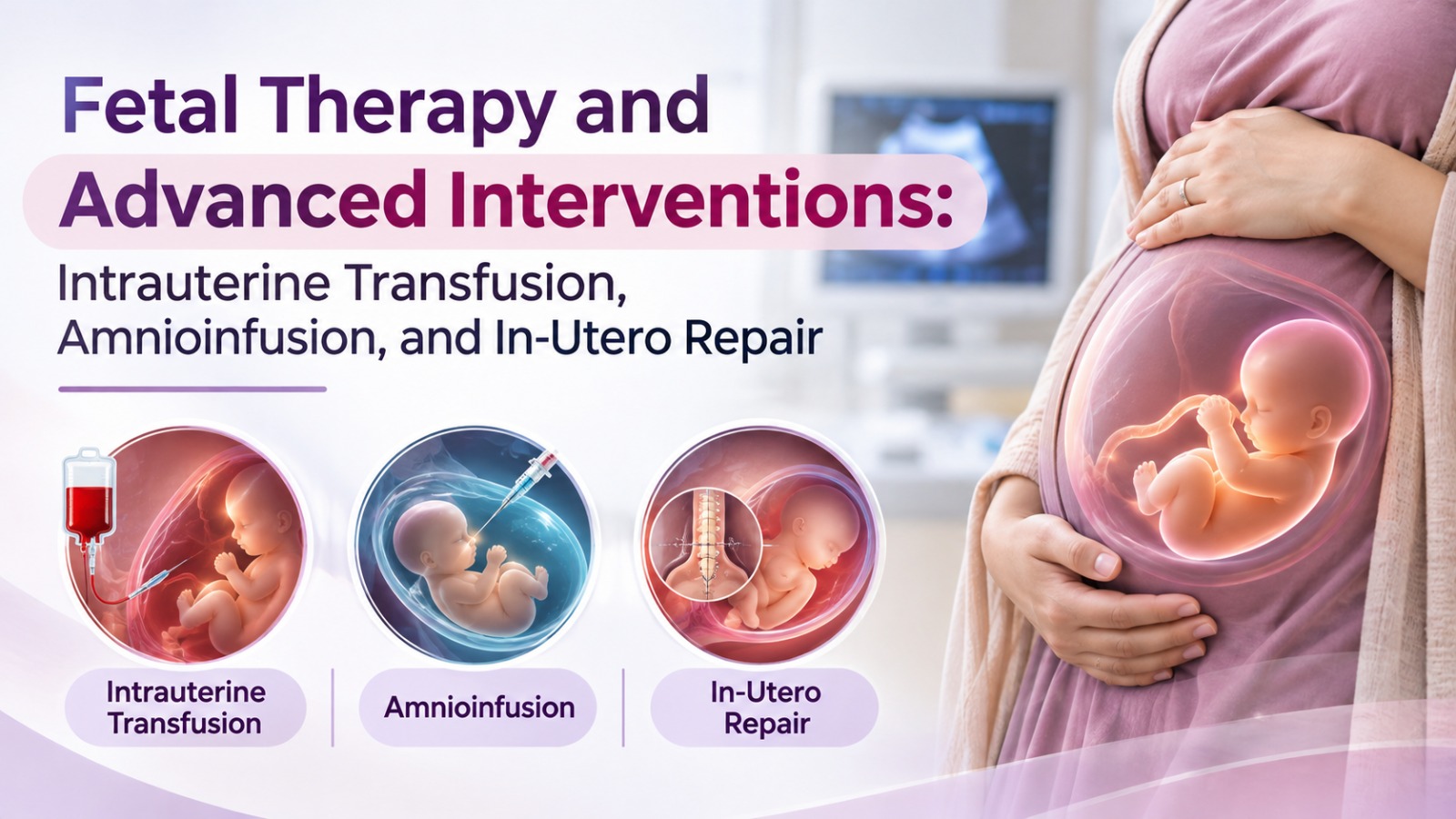
Not long ago, a problem found in the womb could only be watched until the baby was born. Today, advances in ultrasound and minimally invasive techniques allow some conditions to be treated before birth. This branch of fetal medicine is called fetal therapy.
If a scan has shown a concern with your baby, hearing words like “transfusion” or “fetal surgery” can feel overwhelming. This guide explains what fetal therapy is, how three key procedures (intrauterine transfusion, amnioinfusion and in-utero repair) work, and what to ask your doctor.
What Is Fetal Therapy?
Fetal therapy means medical or surgical treatment given to the baby, or to the pregnancy environment, while the baby is still in the womb. The aim is to correct or reduce a problem that could harm the baby’s growth or health if left untreated.
Most procedures are performed through the mother’s abdomen under continuous ultrasound guidance, and many are minimally invasive. They are advised only after a detailed assessment by a fetal medicine specialist, since not every condition can or should be treated before birth.
When Is Fetal Therapy Considered?
Fetal therapy may be discussed when a detailed scan or test shows:
- Severe anemia in the baby.
- Very low amniotic fluid.
- A structural problem such as spina bifida.
- Complications in twin pregnancies that share a placenta.
- Fluid collections or blockages affecting the baby’s organs.
A TIFFA (Level 2) scan, Doppler studies and follow-up scans help identify these conditions early, which is often when treatment works best.
Intrauterine Transfusion (IUT)
What Is It?
An intrauterine transfusion is a procedure in which compatible blood is given to the baby while still in the womb. It treats fetal anemia, a condition in which the baby does not have enough red blood cells to carry oxygen.
Why Is It Needed?
Common causes of fetal anemia include:
- Rh (or other blood group) alloimmunization: An Rh-negative mother’s antibodies attack her Rh-positive baby’s red blood cells.
- Certain infections, such as parvovirus B19.
- Some genetic or blood conditions in the baby.
Untreated severe anemia can lead to heart strain, fluid build-up (hydrops) and, in serious cases, loss of the pregnancy.
How Is Fetal Anemia Detected?
Doctors use a painless Doppler ultrasound to measure blood flow speed in the baby’s middle cerebral artery (MCA). A faster flow suggests anemia. Blood tests on the mother, including antibody levels, also guide decisions.
How Is the Procedure Done?
- A detailed scan locates the baby, the placenta and the umbilical cord.
- After the abdomen is cleaned and numbed, a thin needle is guided through the abdomen into the umbilical vein (or, in some cases, the baby’s abdomen).
- A small sample confirms the baby’s blood count, and compatible blood is then transfused slowly.
- The baby’s heartbeat is monitored throughout.
Transfusions are usually performed from around 18 weeks of pregnancy and may need to be repeated every few weeks, depending on the baby’s response.
What Are the Risks?
Risks include a small chance of bleeding, infection, changes in the baby’s heart rate, preterm labour and pregnancy loss. These are lower when the procedure is done by an experienced fetal medicine team, and the benefit usually outweighs the risk when the baby has severe anemia.
Amnioinfusion
What Is It?
Amnioinfusion is a procedure in which a sterile fluid, usually warm saline, is introduced into the amniotic sac to restore the fluid around the baby.
When Is It Done?
- Very low amniotic fluid (oligohydramnios), especially when the cause is leaking membranes and the aim is to protect the baby’s development.
- To make diagnostic scans clearer when low fluid makes the baby hard to see.
- During labour, in selected cases, to reduce pressure on the umbilical cord or to dilute thick meconium-stained fluid.
How Is It Done?
During a transabdominal amnioinfusion for pregnancy-related causes, the doctor uses ultrasound to guide a fine needle through the abdomen into the fluid pocket and then slowly infuses warm sterile saline. During labour, a thin catheter placed through the cervix is used instead.
Is It Safe?
It is generally considered safe when carefully monitored. Possible risks include infection, fluid leakage, contractions and, rarely, membrane rupture. The effect may be temporary, so your doctor may combine it with treating the underlying cause and close monitoring.
In-Utero Repair (Fetal Surgery)
What Is It?
In-utero repair refers to surgery on the baby before birth to correct a structural problem. The best-known example is prenatal myelomeningocele repair, surgery for open spina bifida, in which the baby’s spinal cord is exposed through an opening in the back.
Why Repair Spina Bifida Before Birth?
In open spina bifida, the exposed spinal cord can be damaged by contact with amniotic fluid as pregnancy progresses. Research has shown that closing the defect before birth can reduce the need for a shunt for hydrocephalus (fluid on the brain) and may improve some aspects of movement, compared with repair after birth.
Who Is Eligible?
Prenatal surgery is possible only in carefully selected cases. Doctors usually look at:
- The baby’s gestational age, typically within a narrow window in mid-pregnancy.
- The exact level and type of the defect.
- Absence of other major abnormalities.
- The mother’s health and suitability for surgery.
- Detailed counseling and the family’s informed decision.
Open vs Fetoscopic Repair
- Open fetal surgery: The uterus is opened to repair the defect.
- Fetoscopic repair: The repair is done using tiny instruments through small openings, which may reduce stress on the uterus.
What Are the Risks?
Fetal surgery carries significant risks, including preterm birth, membrane rupture, uterine complications and the need for caesarean delivery in this and future pregnancies. It is therefore offered only at highly specialised centres, and families receive detailed counseling about benefits and risks.
Other Conditions Treated by Fetal Therapy
Beyond these three procedures, fetal medicine specialists may also manage:
- Twin-to-twin transfusion syndrome (TTTS): Laser treatment of the shared placental vessels.
- Fluid around the lungs (pleural effusion): Draining or shunting the fluid.
- Lower urinary tract blockage: Procedures that restore urine drainage.
- Congenital diaphragmatic hernia: Selected cases may be considered for specialised procedures.
Not all of these are available at every centre, and some may require referral. A fetal medicine specialist can tell you what is best for your baby and where to go for it.
What Happens Before and After a Fetal Procedure?
Before
- A detailed scan and review of all reports.
- Counseling about benefits, risks and alternatives.
- Blood group and antibody checks.
- Written consent.
After
- A period of observation, and for some procedures a short hospital stay.
- Rest and avoidance of strenuous activity as advised.
- Follow-up scans to check the baby’s response.
- Immediate medical help if you notice bleeding, fluid leakage, fever, severe pain or reduced baby movements.
Fetal Therapy in Hyderabad: Why Choose a Fetal Medicine Specialist
Deciding on a treatment for your unborn baby is one of the hardest choices a parent can face. A fetal medicine specialist can explain your baby’s diagnosis in clear language, tell you honestly whether a procedure will help and plan every step with you, including referral if a specific treatment needs a specialised centre.
If you are looking for a fetal therapy centre in Hyderabad or advice on intrauterine transfusion in Hyderabad, Dr. Navya KC provides detailed fetal assessment, high-risk pregnancy care, genetic counseling and guidance on advanced fetal interventions with compassion and clarity. Book a consultation to understand your options and plan the next step with confidence.
Frequently Asked Questions
What is fetal therapy?
It is treatment given to the baby or pregnancy while the baby is still in the womb.
What is an intrauterine transfusion?
It is a procedure that gives compatible blood to a baby with severe anemia before birth.
When is an intrauterine transfusion done?
Usually from about 18 weeks, when the baby has anemia that may become dangerous.
What is amnioinfusion?
It is the introduction of sterile fluid into the amniotic sac to restore low fluid levels.
Is amnioinfusion safe?
It is generally safe with careful monitoring, though infection, leakage and contractions are possible risks.
Can spina bifida be treated before birth?
Yes, selected cases of open spina bifida can be repaired before birth.
What is prenatal myelomeningocele repair?
It is surgery on the baby’s spine in the womb to close an open spinal defect.
Are fetal procedures risky?
Yes, they carry risks such as infection and preterm labour, so they are advised only when benefits outweigh them.
Do I need a fetal medicine specialist for these procedures?
Yes, they need specialised training, ultrasound skills and team support.
Are all fetal therapies available in Hyderabad?
Availability varies by procedure, and your specialist can advise on local options or referral.
Final Thoughts
Fetal therapy gives many families a chance to treat a problem before their baby is born. Intrauterine transfusion, amnioinfusion and in-utero repair each address a different condition, and each is advised only after careful assessment. Early detection through timely scans makes more options possible. If a scan has raised a concern, consult a fetal medicine specialist promptly for clear answers and a personalised plan.
Disclaimer: This article is for general educational purposes only and is not a substitute for professional medical advice, diagnosis or treatment. Please consult a qualified doctor regarding your pregnancy and health.



.jpeg)