 +91 9618519486

 Yashoda Hospital,
Hitec City
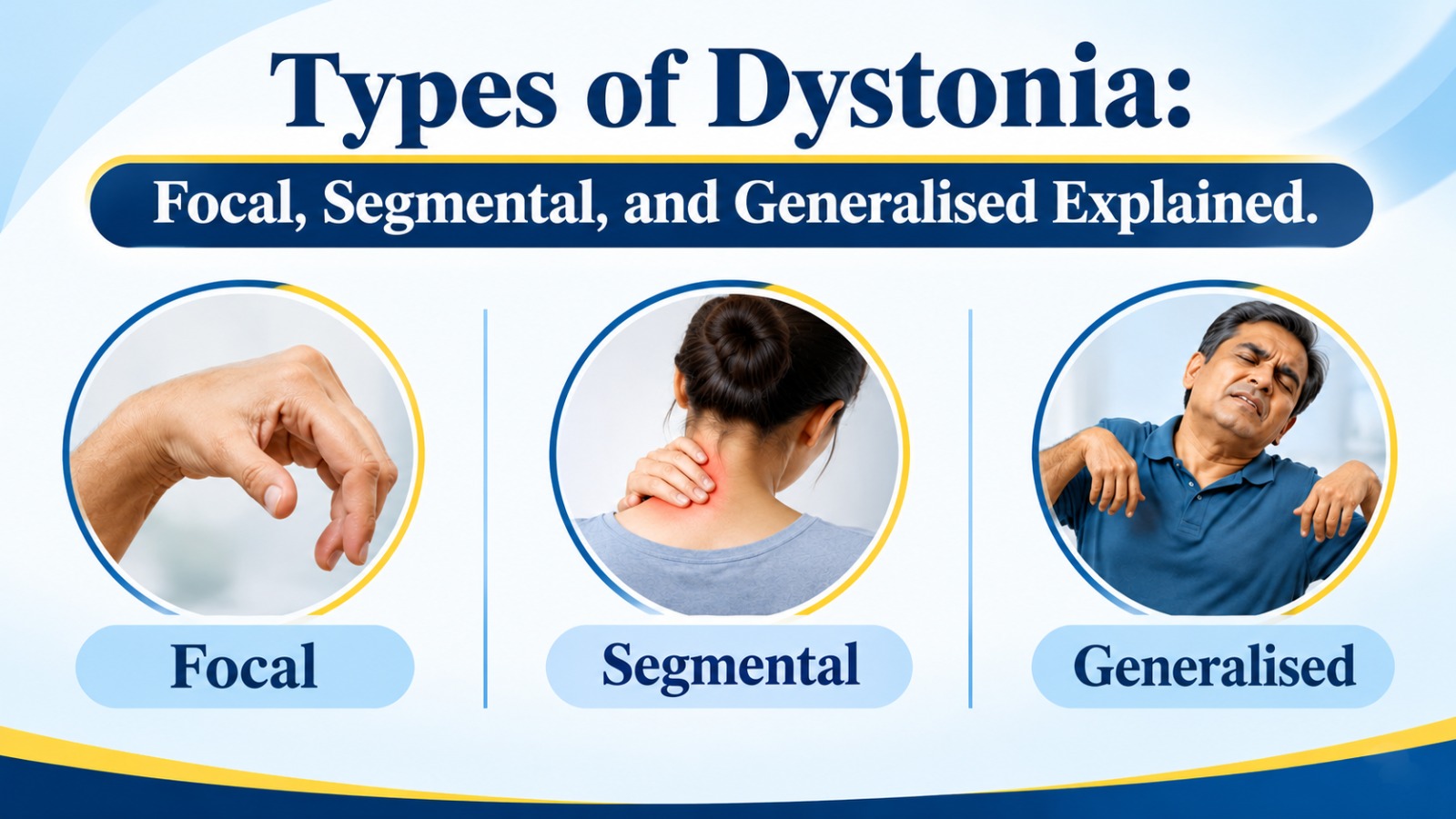
Dystonia is not one single, uniform condition. It may affect one small area, such as the eyelids or a hand, or involve large parts of the body. Knowing the types of dystonia is important because the type influences the symptoms, the likely causes, and the treatment options.
Doctors classify dystonia in three main ways: by the parts of the body affected, by age at onset, and by cause. This article explains each of these with common examples. For a wider overview, read our guide on what dystonia is, including its symptoms and causes.
How Is Dystonia Classified?
A neurologist usually considers the following:
- Body distribution: Which areas are involved (focal, segmental, multifocal, generalised, or hemidystonia).
- Age at onset: Childhood-onset or adult-onset.
- Pattern over time: Constant, triggered by a specific task, changing through the day, or occurring in episodes.
- Associated features: Whether dystonia is the only problem (isolated) or occurs along with other movement disorders or neurological features (combined).
- Cause: Inherited, acquired, or idiopathic (no cause found).
The most familiar way to describe dystonia is by body distribution, so let us begin there.
Types of Dystonia by Body Distribution
Dystonia can be classified into five main types based on the body regions affected.
| Type | Areas Affected | Example |
|---|---|---|
| Focal | One body area | Cervical dystonia, blepharospasm |
| Segmental | Two or more neighbouring areas | Eyelids and jaw together |
| Multifocal | Two or more areas that are not neighbours | One arm and the opposite leg |
| Generalised | Trunk plus at least two other areas, usually including the legs | Childhood-onset inherited dystonia |
| Hemidystonia | One side of the body | After a stroke or other brain injury |
Focal Dystonia
In focal dystonia, only one part of the body is affected. This is the most common pattern in adults, and it often begins in middle age. Common forms include:
- Cervical dystonia (spasmodic torticollis): The neck turns, tilts, or pulls forward or backward, sometimes with pain and head tremor. It is the most common focal dystonia in adults.
- Blepharospasm: Involuntary blinking or closure of the eyelids, which can make reading, driving, or walking outdoors difficult.
- Oromandibular dystonia: Spasms of the jaw, lips, or tongue that may affect chewing and speech.
- Laryngeal dystonia (spasmodic dysphonia): The vocal cords are affected, producing a strained, tight, or breathy voice.
- Limb dystonia: An arm, hand, leg, or foot takes up an abnormal posture.
- Task-specific dystonia: Symptoms appear only during a particular skilled activity, such as writer's cramp or musician's dystonia, while other uses of the hand feel normal.
Focal dystonia may remain in one area, although in some people it spreads to nearby regions. Read more about Cervical Dystonia (Torticollis): Causes and Treatment and Focal Dystonia: Causes, Symptoms and Treatment Options.
Segmental Dystonia
Segmental dystonia involves two or more adjacent body regions. A well-known example is Meige syndrome, in which blepharospasm occurs together with oromandibular dystonia, affecting the eyelids and the lower face. Another example is the neck and one arm being affected together.
Multifocal Dystonia
In multifocal dystonia, two or more body regions that are not next to each other are involved, for example, one arm and the opposite leg, or the eyelids and a foot. When dystonia appears in several separate areas, doctors look carefully for an underlying cause.
Generalised Dystonia
Generalised dystonia affects the trunk and at least two other body regions, usually including the legs. It often begins in childhood or adolescence, and it frequently starts in a foot or leg before spreading. Some cases are inherited, such as those linked to TOR1A, while others have different causes. Severity varies considerably from person to person.
Dopa-responsive dystonia is a childhood-onset form that can look like generalised or limb dystonia and often improves markedly with levodopa. This is why doctors consider a trial of levodopa in young patients.
Hemidystonia
Hemidystonia affects one side of the body, often the arm and leg together. It is frequently secondary to damage on the opposite side of the brain, such as a stroke or injury. Symptoms may appear some time after the original event.
Types of Dystonia by Age at Onset
- Childhood-onset dystonia: Often starts in a limb and may spread. It is more likely to have a genetic or early brain injury cause, although this is not always so.
- Adult-onset dystonia: Usually focal, most often affecting the neck, eyelids, voice, or hand, and a cause frequently cannot be identified.
Types of Dystonia by Pattern
- Persistent dystonia: Present most of the time.
- Action-specific dystonia: Occurs only during a particular activity.
- Diurnal variation: Symptoms change through the day, as in some dopa-responsive dystonia.
- Paroxysmal dystonia: Comes in episodes, sometimes triggered by movement, exertion, or other factors, with normal movement between attacks.
Isolated and Combined Dystonia
In isolated dystonia, dystonia is the only movement problem, apart from tremor. In combined dystonia, it occurs together with another movement disorder, such as myoclonus or parkinsonism, or with other neurological features. This distinction helps doctors decide which tests to advise.
See Dystonia vs. Parkinson's Disease: Key Differences to understand how the two conditions overlap and differ.
Why Does Knowing the Type of Dystonia Matter?
The type shapes the next steps:
- Likely causes and tests: Young-onset or multifocal dystonia may need blood tests, MRI, and genetic testing, while adult-onset focal dystonia often needs fewer investigations. See What Causes Dystonia? Common Triggers and Risk Factors.
- Treatment choices: Botulinum toxin injections are commonly used when one or a few areas are involved. Medicines, therapy, and, for selected people with severe dystonia, deep brain stimulation (DBS) may be considered when many areas are affected. The right plan depends on the type, severity, and cause, as explained in Dystonia Treatment Options.
- Outlook and monitoring: Some focal dystonias stay localised, while others change over time.
When Should You See a Specialist?
Consult a neurologist if you notice involuntary twisting, a neck that stays tilted, eyelid spasms, voice changes, or hand cramping that interferes with daily life.
Seek urgent medical help if symptoms start suddenly, especially along with weakness, difficulty in speaking, or problems with swallowing or breathing. These need prompt assessment and should not wait for a routine appointment.
Consulting a Dystonia Specialist in Hyderabad
An experienced movement disorder specialist can identify the type of dystonia, look for an underlying cause, and plan treatment. Prof. Dr. Rupam Borgohain assesses and treats dystonia and other movement disorders at PDMDRC Centre.
To book a consultation, call 9618519486 or book a consultation online.
Frequently Asked Questions
What are the main types of dystonia?
By body distribution, the types are focal, segmental, multifocal, generalised, and hemidystonia. Dystonia is also described by age at onset, pattern over time, and cause.
What is the most common type of dystonia?
In adults, focal dystonia is the most common pattern, and cervical dystonia is the most common focal form.
What is the difference between focal and generalised dystonia?
Focal dystonia affects one body area. Generalised dystonia affects the trunk and at least two other regions.
Can focal dystonia become generalised?
Focal dystonia sometimes spreads to nearby areas, but it often remains limited. The likelihood depends partly on the age at onset and the cause.
Is writer's cramp a type of dystonia?
It can be. Task-specific dystonia causes cramping or an abnormal posture of the hand during a particular activity such as writing.
Which doctor treats dystonia?
A neurologist, preferably one with experience in movement disorders, treats dystonia.
Conclusion
Dystonia can be focal, segmental, multifocal, generalised, or limited to one side of the body, and it is also described by age at onset, pattern, and cause. Identifying the type helps guide investigations and treatment. If you notice persistent involuntary movements or abnormal postures, an assessment by a neurologist is the first step.
To arrange a consultation with Prof. Dr. Rupam Borgohain, book an appointment.
Disclaimer: This article is for general information and does not replace personal medical advice. Please consult a qualified neurologist for diagnosis and treatment.