 +91 9618519486

 Yashoda Hospital,
Hitec City
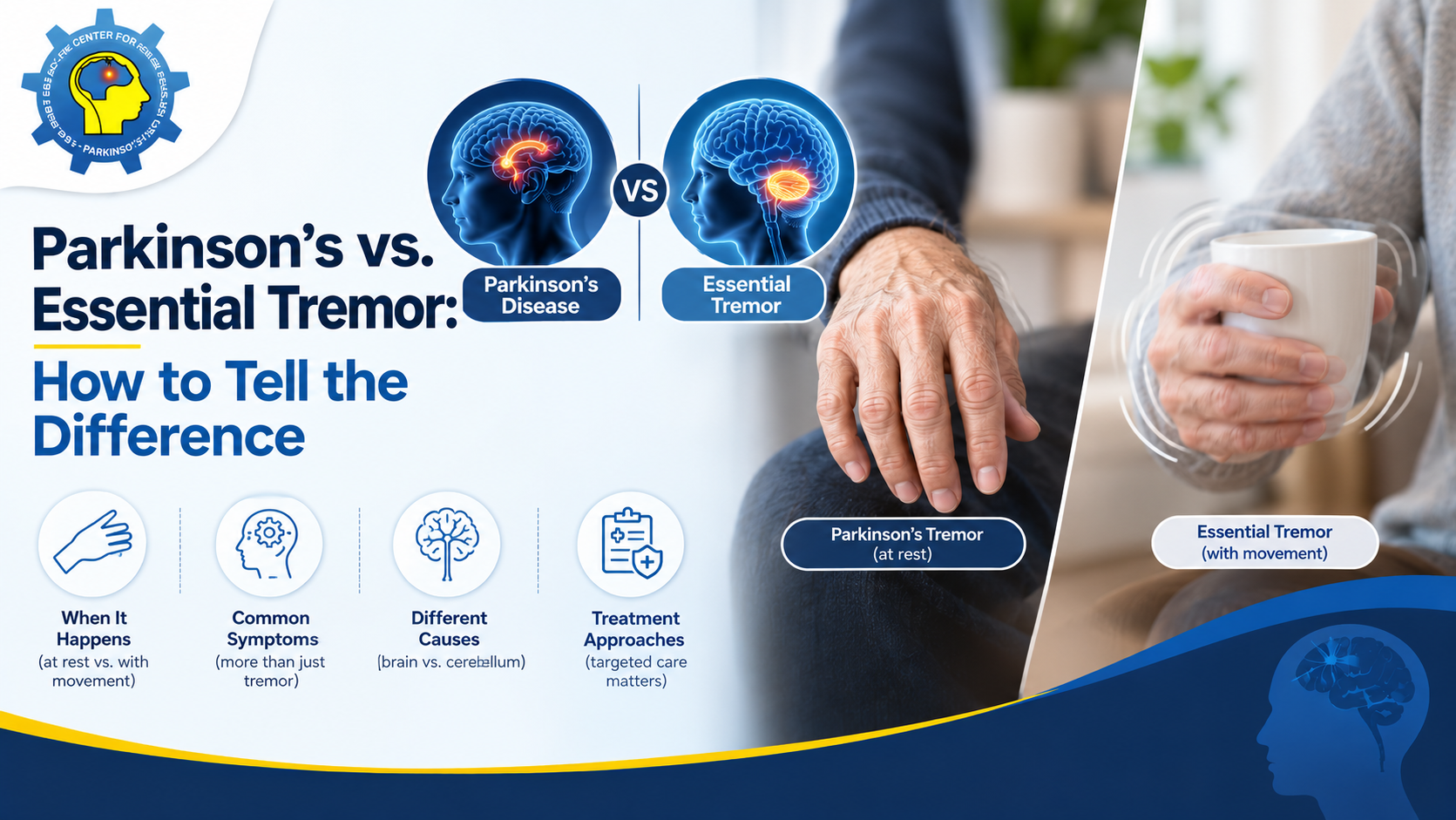
A shaking hand is one of those symptoms that immediately makes people think of Parkinsons disease. In reality, the most common cause of hand tremors isnt Parkinsons at all; its a condition called essential tremor. The two are frequently confused, partly because they share an obvious surface-level symptom and partly because essential tremor is far more common but far less talked about.
Telling them apart matters. The treatment approach, prognosis, and what to expect over time are quite different for each condition. This guide breaks down exactly how Parkinson's and essential tremor differ, so you know what to look for and when it's worth seeing a neurologist.
What Is Essential Tremor?
Essential tremor is a neurological condition that causes involuntary, rhythmic shaking, most commonly in the hands. It's one of the most common movement disorders, and it tends to run in families, with many people able to trace it back to a parent or grandparent who had a similar "shaky hands" pattern.
Unlike Parkinson's, essential tremor isn't caused by a loss of dopamine-producing brain cells. Its exact cause isn't fully understood, though it's believed to involve abnormal electrical activity in areas of the brain that help coordinate movement, particularly the cerebellum.
What Is Parkinson's Disease?
Parkinson's disease is a progressive neurological condition caused by the gradual loss of dopamine-producing neurons in the brain. Dopamine plays a key role in coordinating smooth, controlled movement, so as levels decline, a range of motor symptoms emerge, including tremor, stiffness, slowed movement, and balance difficulties.
Tremor is one of the hallmark symptoms of Parkinson's, but it's just one piece of a broader set of changes that typically develop over time, many of which are unrelated to movement at all.
The Key Difference: When the Tremor Happens
The single most useful clue for telling these two conditions apart is when the tremor shows up.
- Parkinson's tremor is a resting tremor. It appears when the affected body part is relaxed and not being used, such as a hand resting in the lap. The tremor often lessens or disappears once the person starts using that hand for a task, like picking up a cup.
- Essential tremor is an action tremor. It shows up during voluntary movement or when holding a position against gravity, such as writing, drinking from a glass, or holding a newspaper. It tends to be minimal or absent when the hands are fully at rest.
This distinction alone helps neurologists tell the two apart in many cases, though a full evaluation looks at several other factors as well.
Other Ways to Tell Parkinson's and Essential Tremor Apart
| Feature | Parkinson's Disease | Essential Tremor |
|---|---|---|
| Tremor type | Resting tremor | Action tremor |
| Typical onset | Usually one side of the body first | Usually both hands, fairly symmetric |
| Progression | Spreads to other motor symptoms over time | Tremor may worsen, but other motor symptoms don't typically develop. |
| Other symptoms | Stiffness, slowed movement, balance issues, smaller handwriting, softer voice | Often tremor alone, sometimes head or voice tremor |
| Family history | Less commonly hereditary | Frequently runs in families |
| Effect of alcohol | Typically no effect | Symptoms often temporarily improve with alcohol. |
| Age of onset | Often after age 60, though early-onset cases exist | Can begin at any age, including young adulthood |
None of these differences is diagnostic on its own, but together they help build a much clearer picture than the tremor alone.
Can You Have Both Conditions?
Yes. While essential tremor and Parkinson's disease are distinct conditions, it's possible for a person to have both, particularly as they get older. Some research also suggests that having essential tremor may modestly raise the long-term risk of developing Parkinson's later on, though most people with essential tremor never go on to develop Parkinson's disease. This overlap is one more reason a proper neurological evaluation matters more than trying to self-diagnose based on symptoms alone.
Other Early Parkinson's Symptoms to Watch For
Because Parkinson's rarely presents with tremor in isolation, looking at the fuller symptom picture can help clarify which condition fits. Alongside a resting tremor, early Parkinson's symptoms often include stiffness, slowed movement, smaller handwriting, a softer voice, reduced facial expression, and sleep disturbances. For a complete breakdown, see our guide on the early signs of Parkinson's disease.
It's also worth noting that Parkinson's isn't the only condition that can be confused with other neurological disorders presenting with tremor or cognitive changes. If memory or thinking changes are part of the picture rather than movement changes alone, our comparison on Parkinson's vs. Alzheimer's covers how those two conditions differ.
How Doctors Diagnose the Difference
There's no single blood test or scan that definitively separates Parkinson's from essential tremor in every case. Instead, a neurologist typically relies on:
- A detailed physical exam, observing the tremor at rest versus during action, along with muscle tone, movement speed, and balance
- Symptom history, including family history, how the tremor started, and how it has changed over time
- Response to Parkinson's medication, since Parkinson's tremor typically responds to dopaminergic treatment, while essential tremor generally does not
- Imaging studies, such as a DaTscan, which can help visualize dopamine activity in the brain in cases where the diagnosis isn't clear from the exam alone
Treatment Differences
Because the underlying causes are different, treatment approaches diverge as well.
Essential tremor is often managed with medications such as beta-blockers or certain anti-seizure drugs, which can reduce tremor severity, though they don't address an underlying dopamine deficiency since none exists. Lifestyle adjustments, like minimizing caffeine, can also help some people.
Parkinson's disease is typically managed with dopaminergic medications that help replace or mimic the brain's declining dopamine supply, alongside physical therapy and, in appropriate cases, other treatment options as the condition progresses. Because Parkinson's involves more than tremor, treatment plans usually address the broader set of motor and non-motor symptoms as well.
When to See a Neurologist
Any new, persistent hand tremor is worth having evaluated, even if it seems mild. It's especially worth scheduling an appointment if:
- The tremor is more noticeable at rest than during activity
- It started on one side of the body before the other
- It's accompanied by stiffness, slowness, or balance changes
- It's progressively affecting daily tasks like writing, eating, or dressing
A neurologist can distinguish between the two conditions using a combination of exam findings and history and can guide you toward the right treatment path from there.
Frequently Asked Questions
What is the main difference between Parkinson's and essential tremor?
Parkinson's tremor occurs at rest, while essential tremor occurs during movement or when holding a position, such as writing or holding a cup.
Does essential tremor turn into Parkinson's disease?
Not usually. The two are separate conditions, though having essential tremor may modestly raise the long-term risk of Parkinson's in some people.
Can alcohol help tell the two conditions apart?
It can be a clue. Essential tremor symptoms often improve temporarily with alcohol, while Parkinson's tremor typically doesn't respond this way.
Is essential tremor more common than Parkinson's disease?
Yes, essential tremor is significantly more common and affects people across a much wider age range, including younger adults.
Can you have essential tremor and Parkinson's at the same time?
Yes, it's possible to have both conditions, particularly in older adults, which is why a full neurological evaluation is important for an accurate diagnosis.
Final Thoughts
A shaking hand doesn't automatically point to Parkinson's disease, and in fact, essential tremor is the more likely explanation for most people. The clearest distinguishing clue is timing: tremor at rest leans toward Parkinson's, while tremor during activity leans toward essential tremor. Either way, a neurologist can confirm which condition fits and guide the right next steps.
Not sure if it's Parkinson's or essential tremor? Book an appointment with our specialists, or contact us to get a proper evaluation.
This article is intended for informational purposes only and does not constitute medical advice. Please consult a qualified healthcare professional for diagnosis and treatment.