 +91 9618519486

 Yashoda Hospital,
Hitec City
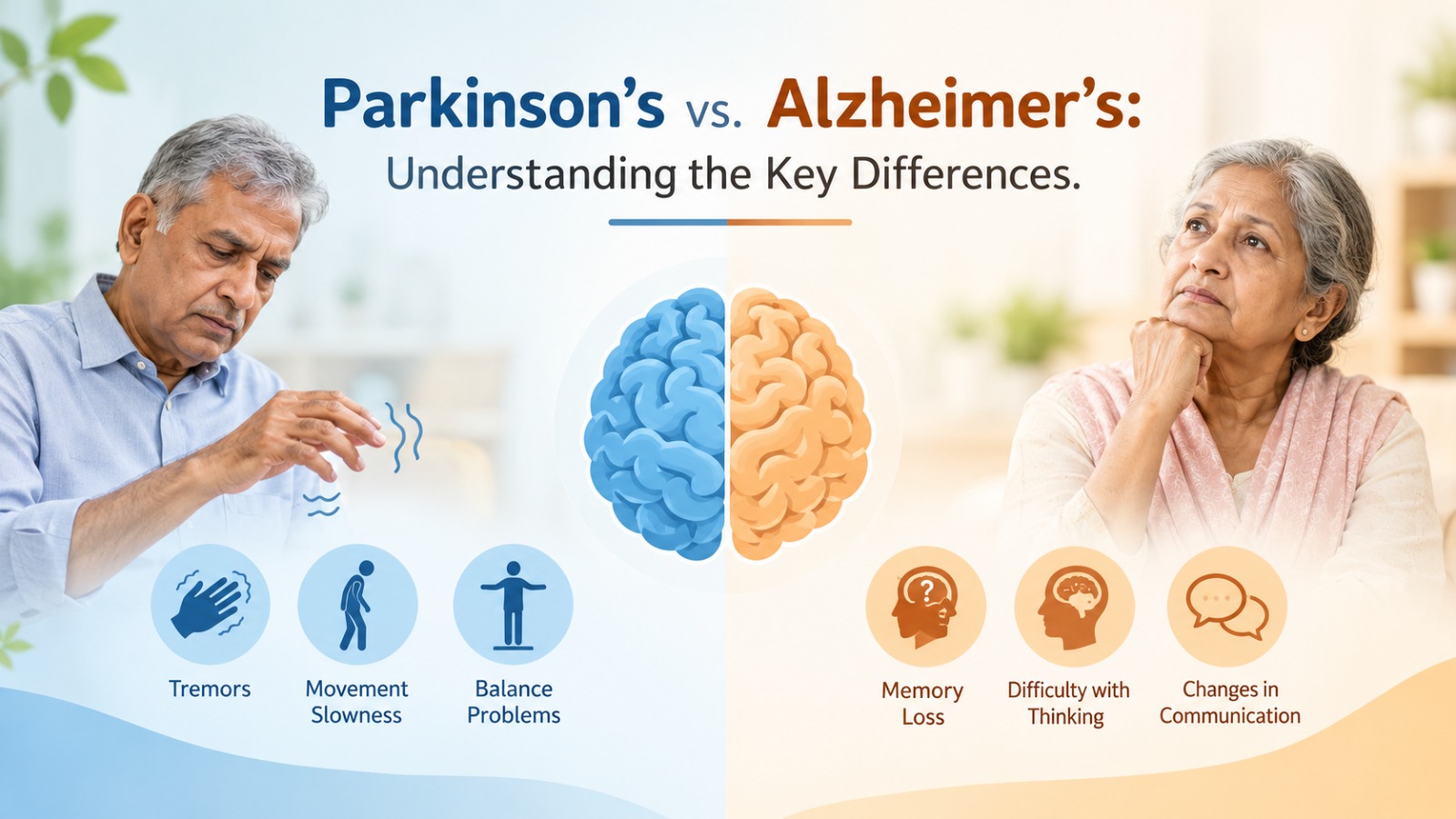
Parkinson's disease and Alzheimer's disease are two of the most common neurological conditions affecting older adults, and they're often mentioned in the same breath. Both are progressive, both become more common with age, and both can involve changes in movement, memory, or mood, which is exactly why the two get confused so often.
But they're fundamentally different conditions, affecting different parts of the brain, with different symptom patterns and different treatment approaches. Understanding those differences can help families recognize what they're actually dealing with and get the right kind of care sooner.
What Is Parkinson's Disease?
Parkinson's disease is a movement disorder caused by the gradual loss of dopamine-producing neurons in a region of the brain called the substantia nigra. Dopamine helps regulate smooth, coordinated movement, so as it declines, motor symptoms like tremor, stiffness, slowed movement, and balance problems begin to appear.
While Parkinson's is best known for its motor symptoms, it also involves a range of non-motor changes, including sleep disturbances, loss of smell, constipation, and in later stages, some cognitive changes as well.
What Is Alzheimer's Disease?
Alzheimer's disease is the most common form of dementia, primarily affecting memory, thinking, and reasoning. It's associated with the buildup of abnormal protein deposits in the brain, known as amyloid plaques and tau tangles, which interfere with communication between neurons and eventually cause brain cells to die.
Unlike Parkinson's, Alzheimer's begins in brain regions tied to memory and learning, particularly the hippocampus, before spreading to other areas involved in language, reasoning, and behavior.
The Core Difference: Movement vs. Memory
The clearest starting point for telling these two conditions apart is which system is affected first.
- Parkinson's disease primarily begins as a movement disorder. Tremor, stiffness, and slowness typically appear before any noticeable memory or cognitive changes.
- Alzheimer's disease primarily begins as a memory disorder. Forgetfulness, confusion, and difficulty with familiar tasks typically appear well before any movement-related symptoms, if they appear at all.
This distinction isn't absolute. Some people with Parkinson's eventually develop cognitive difficulties, sometimes called Parkinson's disease dementia, and some people with Alzheimer's can develop mild motor changes in later stages. But the order in which symptoms appear is usually the biggest clue to which condition is actually present.
Comparing Symptoms Side by Side
| Feature | Parkinson's Disease | Alzheimer's Disease |
|---|---|---|
| Primary system affected | Movement | Memory and cognition |
| Early symptoms | Tremor, stiffness, slowed movement, loss of smell | Forgetfulness, confusion, difficulty finding words |
| Brain chemical involved | Dopamine decline | Amyloid plaques and tau tangles |
| Typical early progression | Motor symptoms first, cognitive changes possible later | Memory symptoms first, motor symptoms rare until advanced stages |
| Common non-motor symptoms | Loss of smell, sleep disturbances, constipation | Mood changes, disorientation, difficulty with daily planning |
| Handwriting changes | Micrographia (smaller handwriting) is common. | Handwriting is usually unaffected until late stages. |
| Personality and mood | Can include depression or anxiety | Can include irritability, apathy, or personality shifts |
Can Loss of Smell Occur in Both Conditions?
Yes, and this is one of the more genuinely confusing overlaps between the two conditions. Loss of smell, or hyposmia, has been documented as an early symptom in both Parkinson's and Alzheimer's disease. In Parkinson's, it's linked to early degeneration in the olfactory bulb, often appearing years before a diagnosis. In Alzheimer's, smell loss is also common and is being studied as a potential early marker as well.
Because this symptom overlaps, it isn't useful for distinguishing the two conditions on its own. What matters more is what other symptoms accompany it. Our guide on loss of smell and Parkinson's covers this connection in more detail.
Can Someone Have Both Conditions?
Yes, it's possible, particularly in older adults. Some people are diagnosed with both Parkinson's disease and Alzheimer's disease, and there's also a related condition called Lewy body dementia, which shares features of both movement and cognitive symptoms and can further complicate diagnosis. This overlap is one of the key reasons a specialist evaluation is so important rather than relying on symptom pattern-matching alone.
How Doctors Tell the Two Apart
Diagnosis typically relies on a combination of approaches rather than a single test:
- Symptom history and timeline. Which symptoms appeared first, movement or memory, is one of the most telling pieces of information.
- Neurological examination. Assessing tremor, muscle tone, gait, and coordination helps identify Parkinson's-specific motor signs.
- Cognitive assessment. Structured memory and thinking tests help evaluate the presence and pattern of cognitive decline associated with Alzheimer's.
- Brain imaging. MRI or specialized scans can help rule out other causes and, in some cases, support a specific diagnosis.
- Response to treatment. Parkinson's motor symptoms often respond to dopaminergic medication, which doesn't apply to Alzheimer's-related memory symptoms.
Treatment Differences
Because the underlying disease processes are different, treatment approaches differ significantly.
Parkinson's disease is primarily managed with medications that replace or mimic dopamine, along with physical therapy, and in select cases, surgical options like deep brain stimulation for patients with more advanced motor symptoms. You can learn more about this option in our guide to DBS Surgery.
Alzheimer's disease is managed with medications aimed at supporting cognitive function and slowing decline, along with structured routines, cognitive engagement, and caregiver support strategies, since there's currently no treatment that reverses the underlying disease process.
When to See a Specialist
It's worth scheduling a neurological evaluation if you or a loved one notices:
- A new tremor, stiffness, or slowness, especially if it starts on one side of the body
- Increasing forgetfulness, confusion, or difficulty with familiar tasks
- A combination of both movement and memory changes appearing together
- Changes in mood, personality, or sleep alongside either of the above
An early, accurate diagnosis makes it easier to plan appropriate treatment and support, whether the underlying condition turns out to be Parkinson's, Alzheimer's, or something else entirely. For a broader look at Parkinson's-specific symptoms, see our guide on Early Signs of Parkinson's Disease .
Frequently Asked Questions
Is Parkinson's a form of dementia?
No, but some people with Parkinson's disease develop cognitive decline later in the disease course, sometimes referred to as Parkinson's disease dementia.
Does Alzheimer's ever cause tremors?
Tremor isn't a typical early symptom of Alzheimer's, though some motor changes can appear in more advanced stages.
Which is more common, Parkinson's or Alzheimer's?
Alzheimer's disease is significantly more common overall and is the leading cause of dementia worldwide.
Can a person have both Parkinson's and Alzheimer's?
Yes, both conditions can occur together, particularly in older adults, and a related condition called Lewy body dementia can also present with overlapping features.
Does loss of smell help tell the two conditions apart?
Not on its own, since smell loss has been linked to both conditions. It's more useful when considered alongside other symptoms.
Final Thoughts
Parkinson's and Alzheimer's affect the brain in different ways, but their occasional symptom overlap makes them easy to confuse without a proper evaluation. Movement changes point more toward Parkinson's, while memory and cognitive changes point more toward Alzheimer's, though either can occur alongside the other. A neurologist can help determine exactly what's going on and guide the right next steps.
Concerned about movement or memory changes in yourself or a loved one? Book an appointment with our specialists, or contact us to schedule an evaluation.
Disclaimer: This article is intended for informational purposes only and does not constitute medical advice. Please consult a qualified healthcare professional for diagnosis and treatment.